Mains power0%

Jordan Eldridge Labs

One person, one facility. Everything I build lives here. Scroll to walk it.

More

JEL is where I keep everything I make. At work, I build the platform a CMMC compliant MSP runs on and automate whatever I can reach. In my free time, I ship products, build tools for the communities I play in, and do security research.

Fabrication

Products built to be used by the world.

More

phob-screen

In flight

A full colour screen on a PhobGCC controller board, running inside the real firmware.
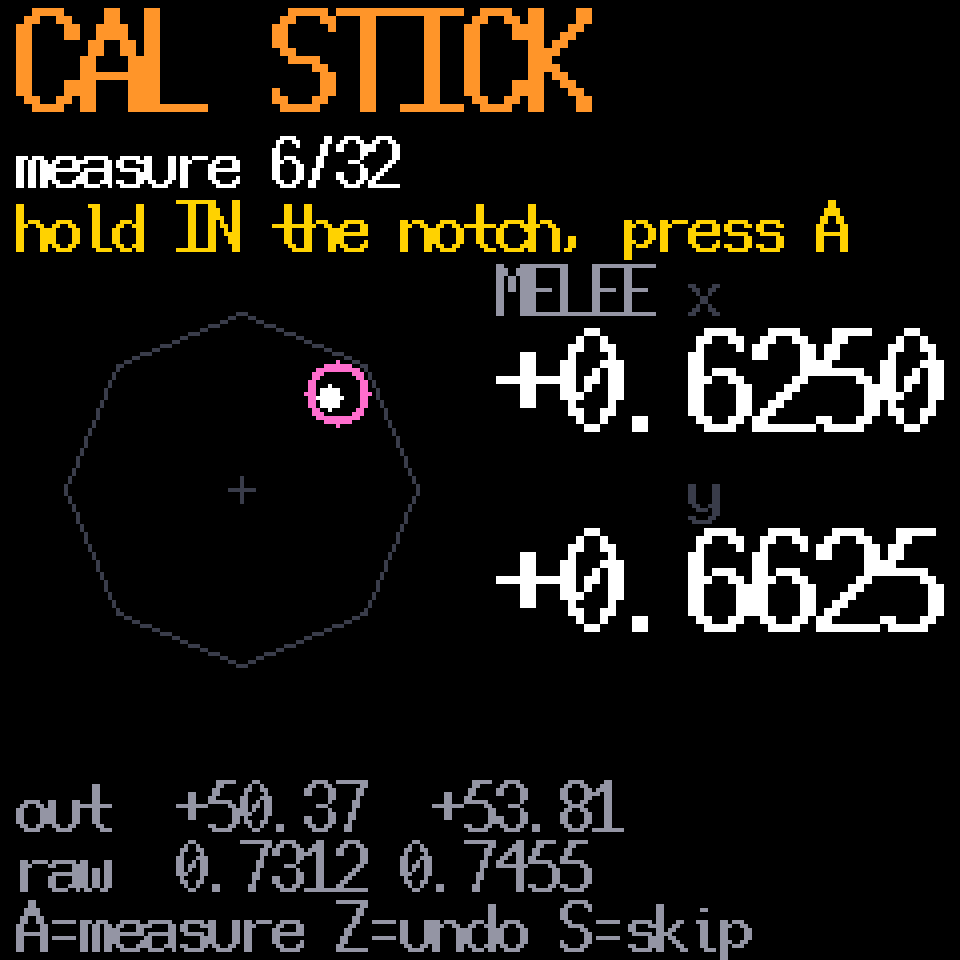
The stick calibration screen, measuring notch 6 of 32 with live x and y readouts.
Measure
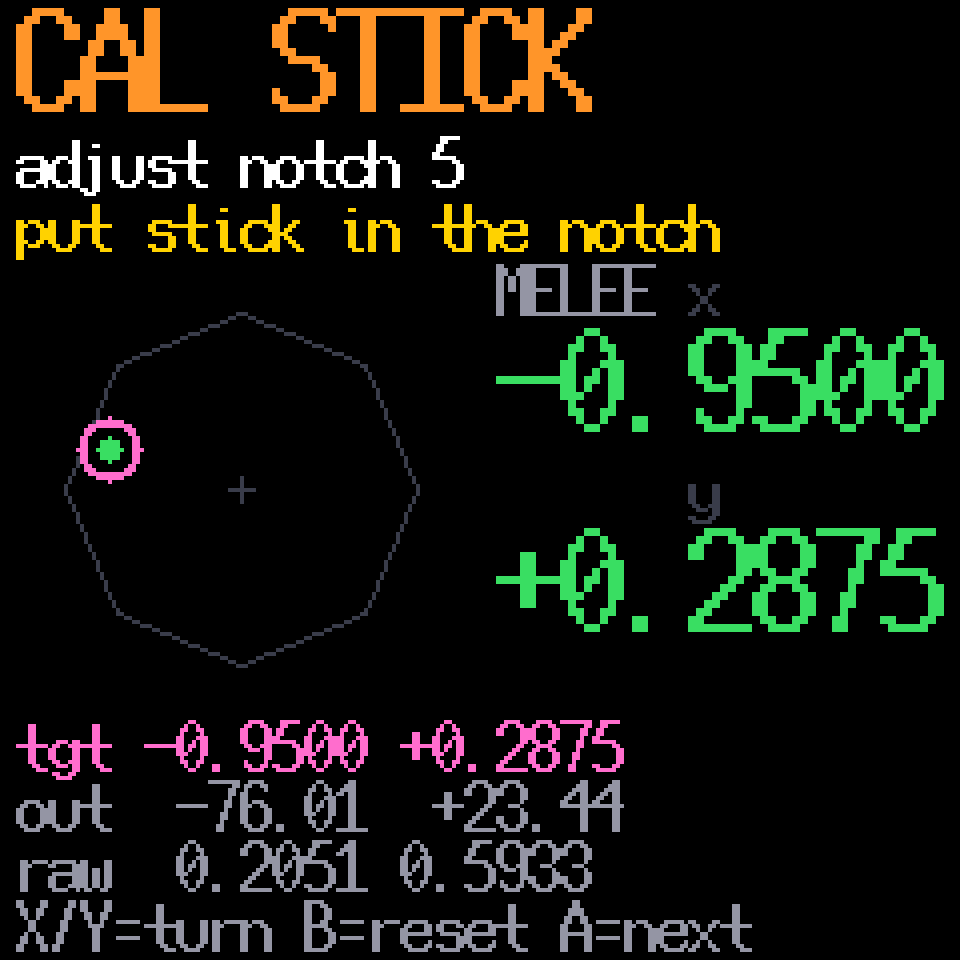
The stick calibration screen adjusting a notch, the readouts green once the stick is on target.
Adjust
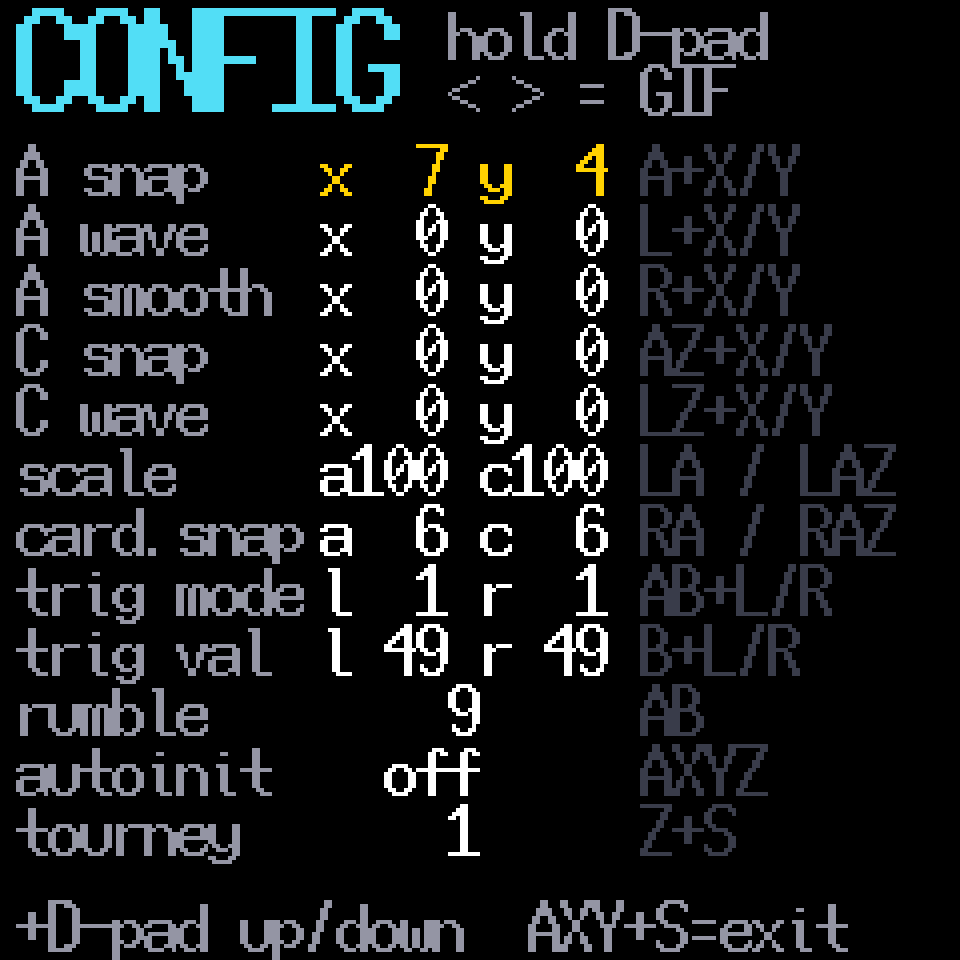
The config page listing every Phob setting, changed with the D-pad.
Config
Princess Peach winking, playing as the idle animation on the controller's screen.
Idle
Panel
240 x 240
Refresh
Up to 30 fps
Hardware
v1 built

The PhobGCC is the open source motherboard that competitive Melee players put in their GameCube controllers. This adds a 1.3 inch colour LCD to it, driven from the board’s own RP2040 through its spare GPIO header. As far as I can tell, nobody has done it this way before.

It is not a demo beside the firmware. It runs inside it. The screen shows a live input dashboard, walks you through stick calibration notch by notch, and plays an animation when the controller is idle. Animations live in their own region of flash, so swapping one never touches the firmware or your calibration.

Hardware v1 is built and it works. It is also ugly. The custom board is on order.

Built with C++, RP2040, Python.
Hollow Knight: Melee

In flight

Play Hollow Knight as Super Smash Bros. Melee characters, running Melee's own recompiled code.

Characters
26
Accuracy
Frame for frame
Platforms
Windows, Linux

A Hollow Knight mod where you play as Fox, or any of the other 25 Melee characters, with movement and combat that match Melee frame for frame.

It does not imitate Melee. A recompiler I wrote turns the PowerPC code on your own Melee disc into C, and that builds into a native library the mod loads. Hollow Knight’s rooms become Melee collision. Hits, hitlag, knockback, grabs and sounds all come from Melee itself.

Nothing from Melee ships with it. One installer finds the game, takes your ISO, backs up your saves and builds the core on your machine.

Built with Python, C, C#.

ezkey.io

In flight

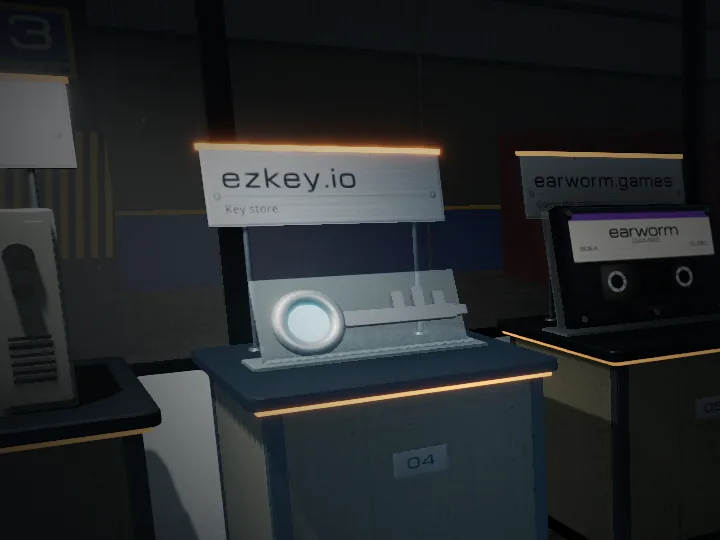
An API key store built for MSPs. My first real SaaS.

The ezkey exhibit in the dispatch office: a steel key a metre long on a lit plinth, under its nameplate.
In the room

MSPs hold hundreds of vendor API keys across dozens of clients, usually in places they should not be. ezkey is a purpose-built store with per-client scoping, rotation, and an audit trail, lightweight for those who don’t require a full PAM solution.

Built with TypeScript, Postgres, Docker.

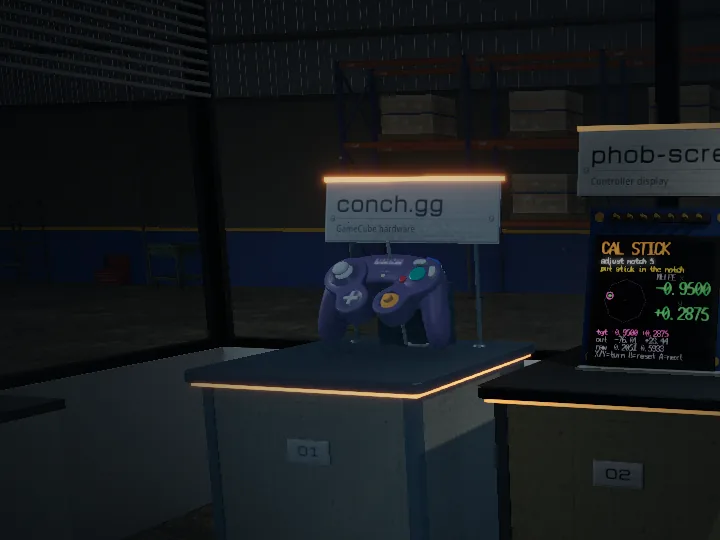
conch.ggIn flightCustom GameCube controllers, and the Rust bridge that puts one in a browser.
The conch.gg exhibit in the dispatch office: an indigo GameCube controller on a lit plinth, under its nameplate.
In the room

A small hardware business: custom built GameCube controllers for players who care as much as I do. The site sells them and hosts the tools I wrote along the way, including a browser-based input viewer.

Underneath that viewer is gc-bridge, a local server in Rust that reads a GameCube adapter and streams its inputs to the browser. Rust so the latency stays out of the way, and open source so others can use it in their own projects.

Built with Rust, TypeScript.

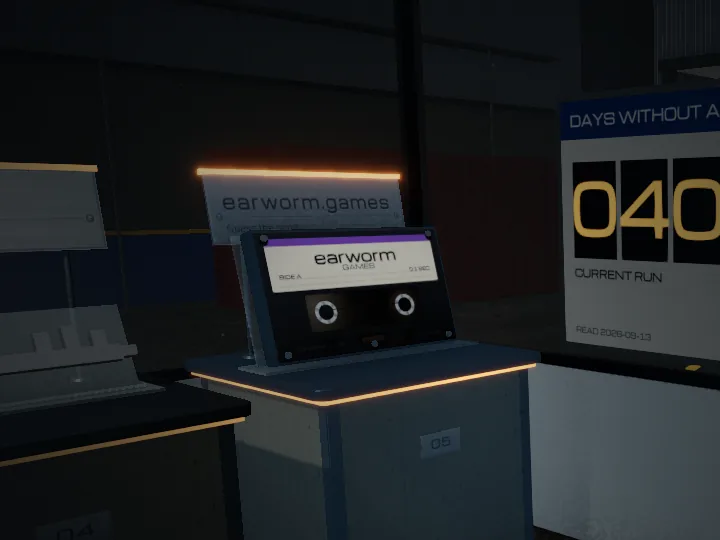
earworm.gamesOperationalA guess-the-song game, built because the ones that already existed did not fit my friend group's needs.
The earworm.games exhibit in the dispatch office: a cassette five times life size on a lit plinth, under its nameplate.
In the room

A clip plays for a tenth of a second and you guess the song. Every wrong guess unlocks a longer slice, up to sixteen seconds.

Games like it already existed. None of them had the library we wanted, so this one has a bigger pool behind it and an interface we like more. Got to learn a lot about audio, volume normalization, encoding, and efficient file formats to make it the best it could be.

Built with SvelteKit, TypeScript, Python, SQLite.

MonitorOperationalA Pop OS desktop app for saying which screen is the primary one, in Rust.

Pop OS will tell you which monitors are connected. It will not tell you which of them is the one on the left. This lists every output with its port, resolution, refresh rate and physical size, sets the primary display in a click, and identifies a screen by dimming every other one for a few seconds.

Rust and egui on top of xrandr. It notices when it is running inside a Flatpak sandbox and proxies its calls back out to the host, which is the part that took the longest.

Built with Rust, egui.

Video compressor for DiscordOperationalTwo-pass H.264 that lands a clip under Discord's limit with the quality left in it.

Discord caps an upload at 10 MB unless you pay for it, and a Melee clip is always just over. This works out the largest bitrate that still fits, runs a two-pass H.264 encode at it, and hands back a file that goes straight into the chat.

Two passes rather than one because the first pass is what lets the second spend its bits where the motion is. A file picker, a progress bar, and the same behaviour on Windows and Linux.

Built with Python, ffmpeg.

Recreation

Tools for the games and communities I'm passionate about.

More

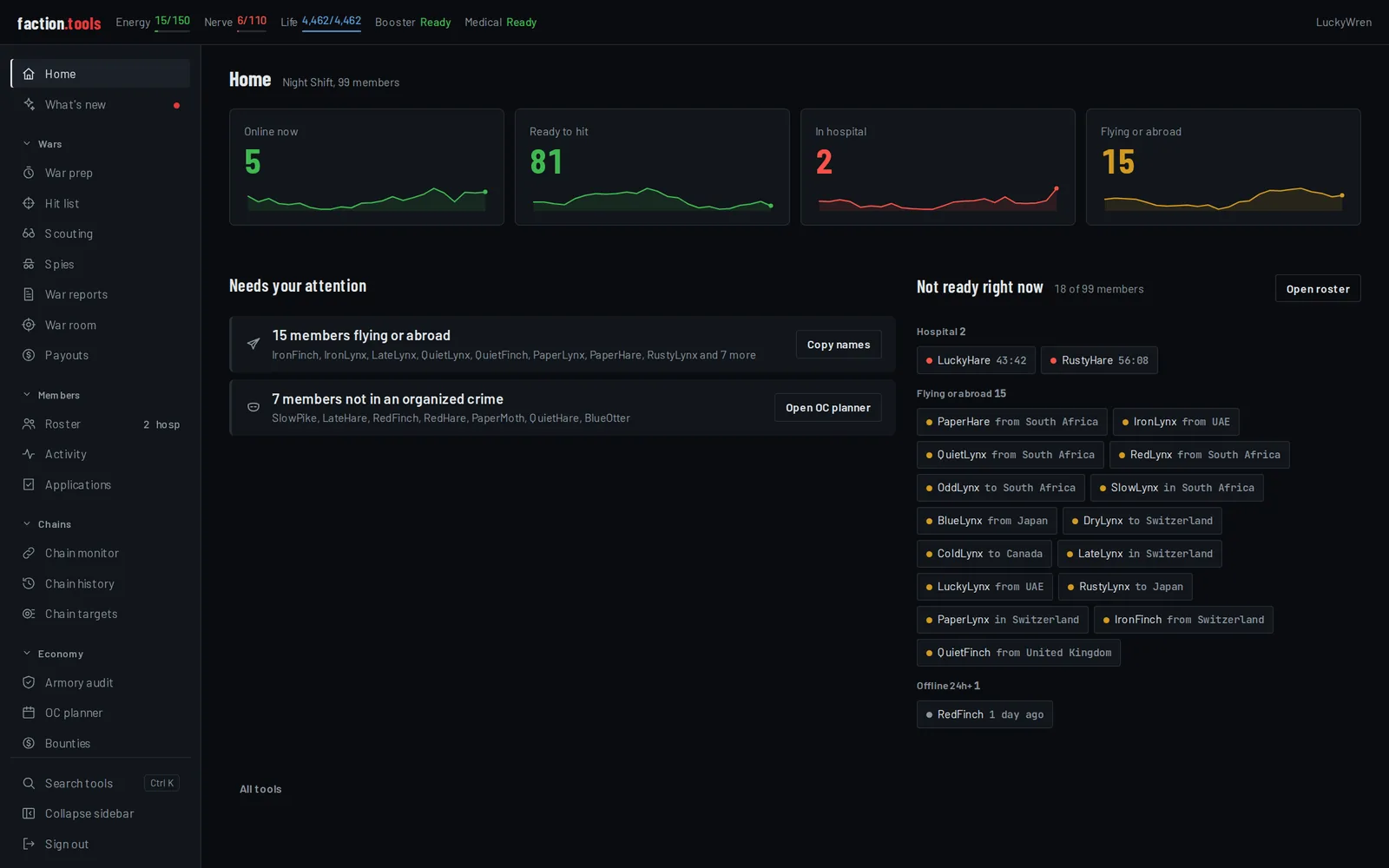
faction.tools

Operational

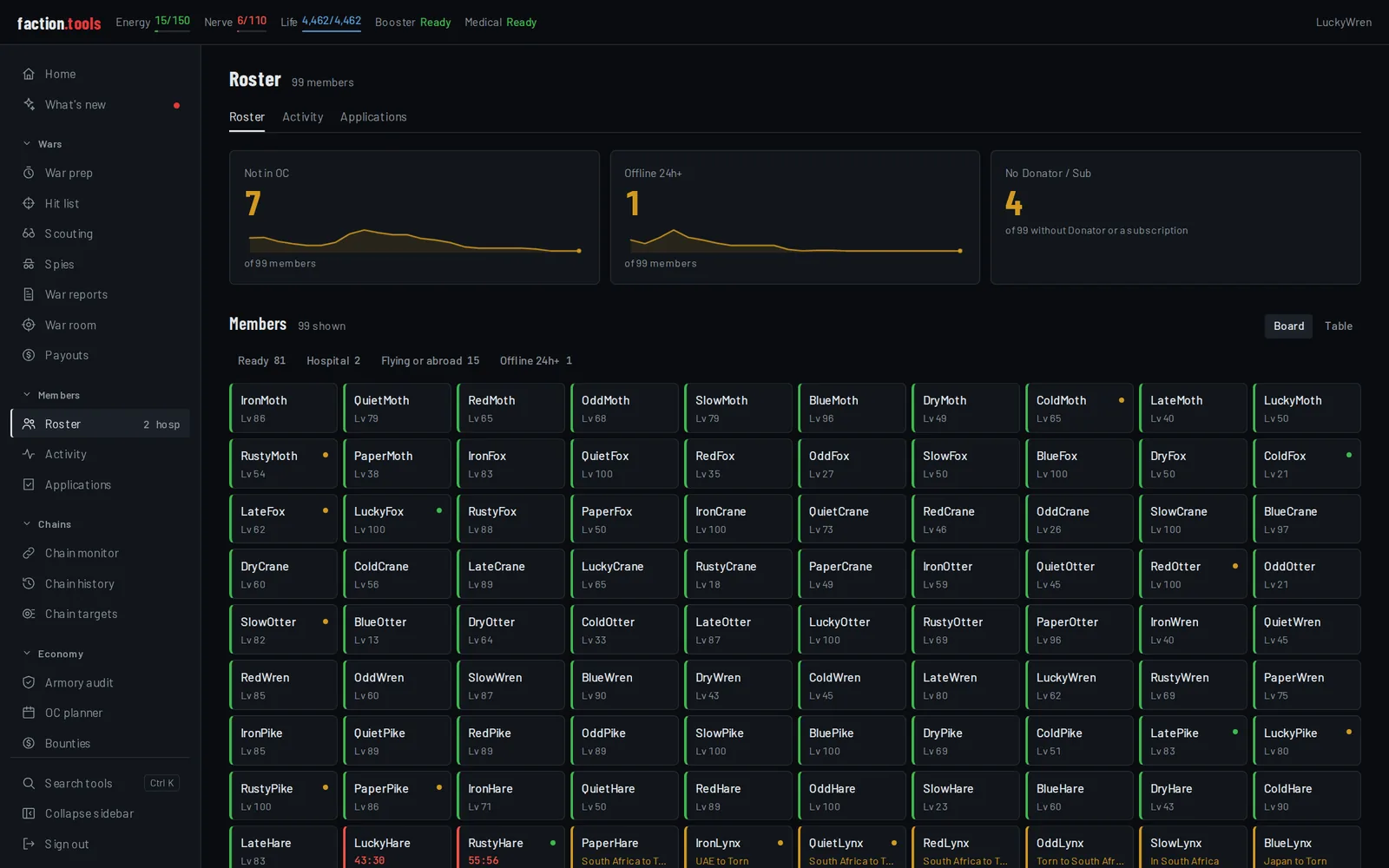
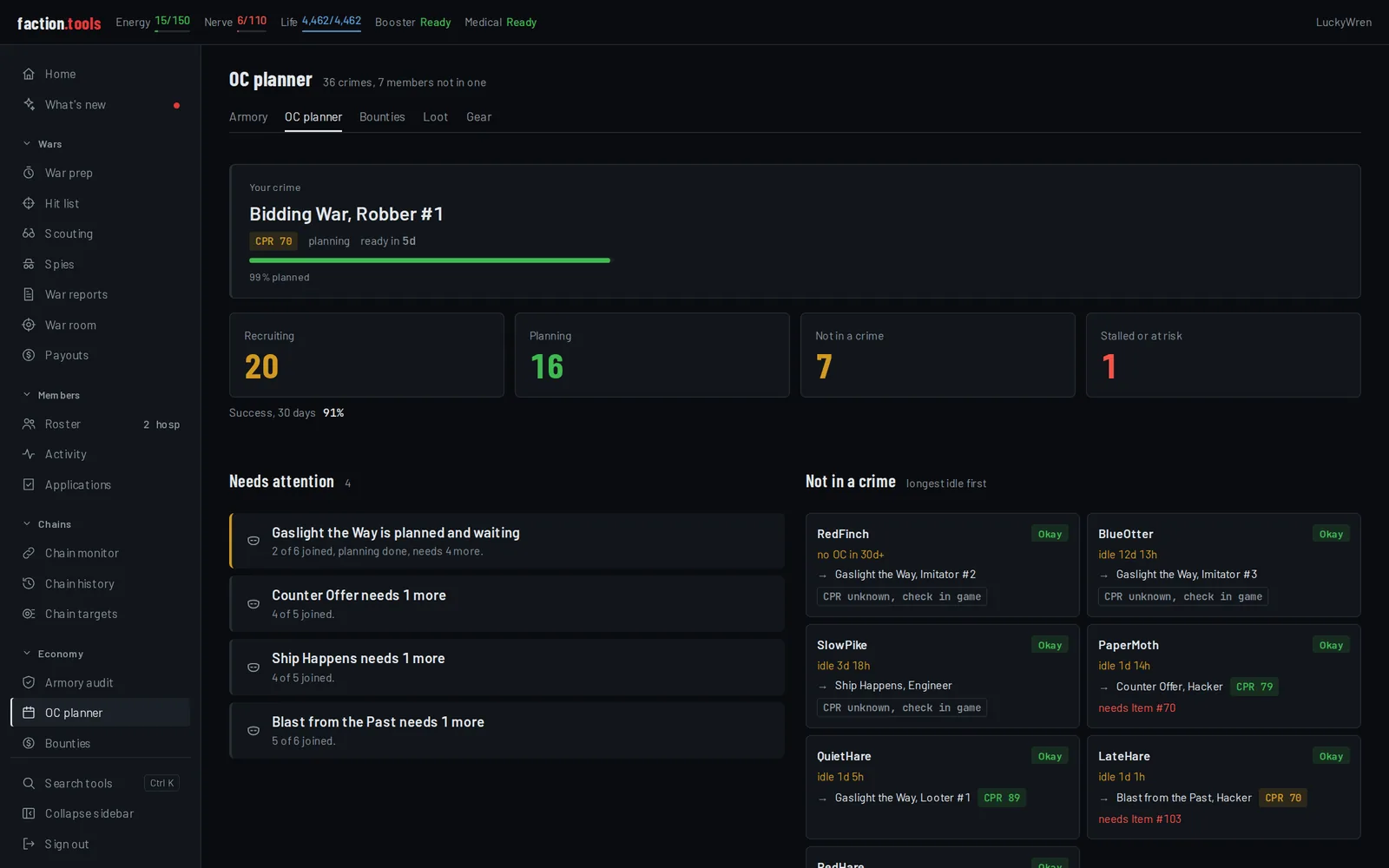
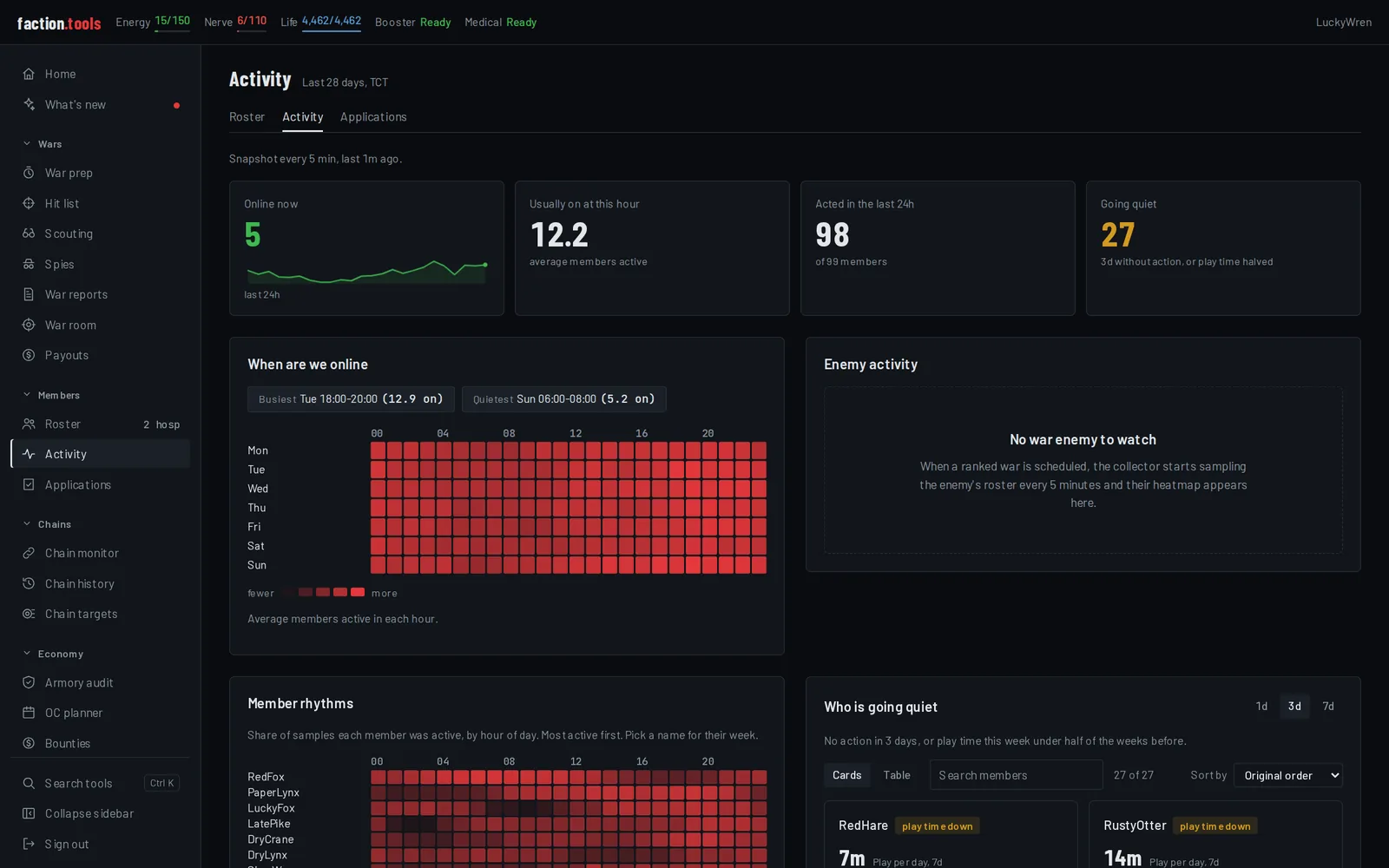
The operations app my Torn City faction runs on, from the war room to payouts.

The faction.tools home screen, with tiles for members online, ready to hit, in hospital and abroad, a list of what needs attention and who is not ready.
Home
The roster as a board of member tiles, each coloured by whether that member is ready, in hospital or travelling.
Roster
The organized crime planner, with counts of crimes recruiting and planning, the ones that need another member, and who is not in one.
Crime planner
The activity page, a heat map of when the faction is online by hour and day, and which members are going quiet.
Activity
Status
Launched
Used by
My own faction

Torn City is a text-based MMO with around 100,000 daily players. Factions are its guilds, and running one well is a lot of bookkeeping. faction.tools replaces the spreadsheets.

It has launched, and my own faction runs on it. There is a war room and war reports, a chain monitor, a target board, an armory audit, payouts, a planner for organized crimes, a roster with activity, a calendar and a newsletter.

Before it, I ran torn.bet, a large and active third party casino for the game’s currency: games, wallets, payouts, and the anti-abuse work that comes with real stakes. It had daily users until new rules on third party gambling meant it had to shut down, and I closed it in line with them.

The pictures are the live app with every member’s name and the faction’s name swapped for made-up ones.

Built for the game Torn City. Some of the game's themes are adult.

Built with TypeScript, Next.js, Prisma, Postgres.

MLPEKAYOU botClosed sourceThe Discord bot for mlpekayou.community, linking members to their card collections.
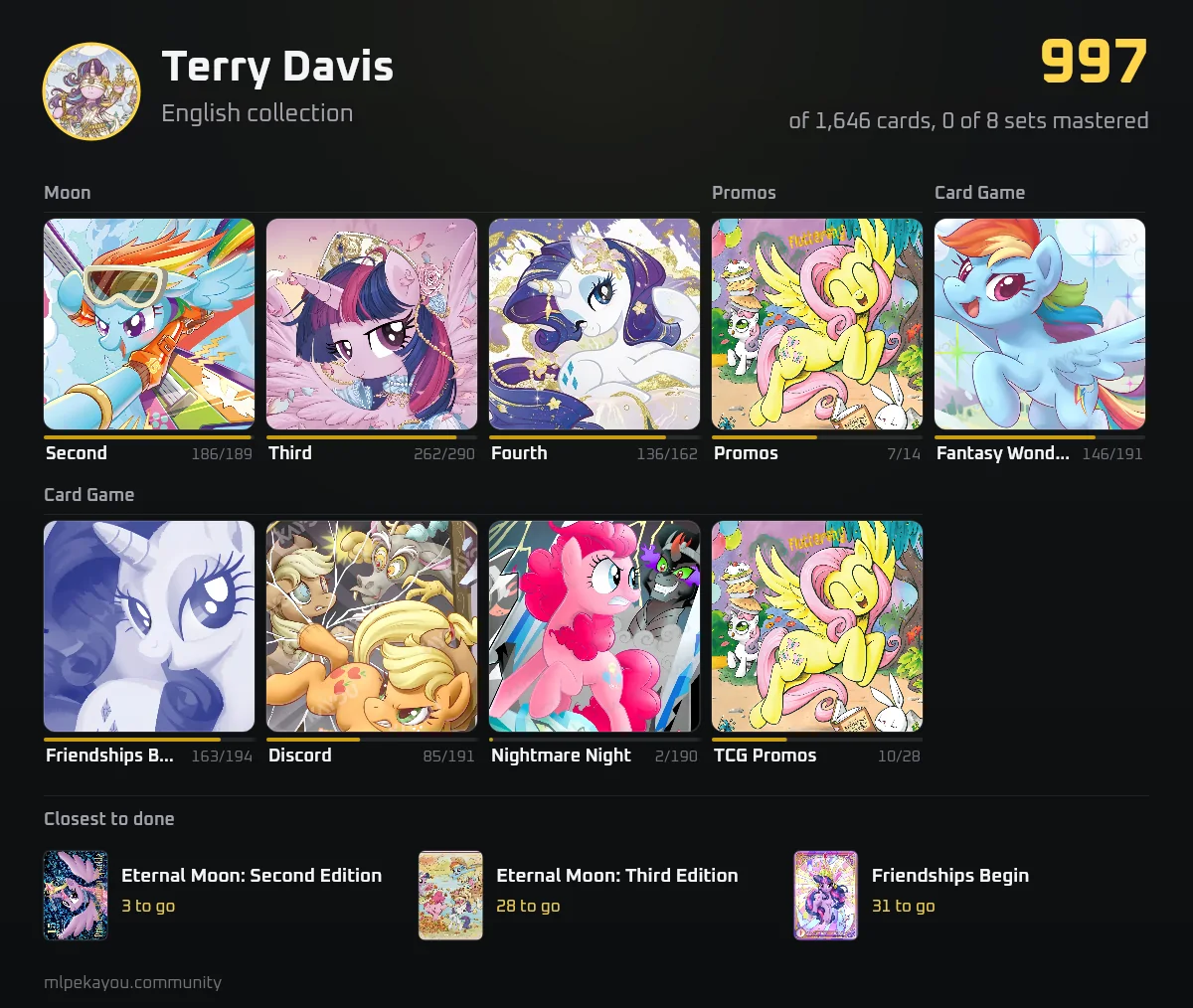
A collection screen drawn by the bot, with a member's sets as card art and a progress bar under each.
Collection
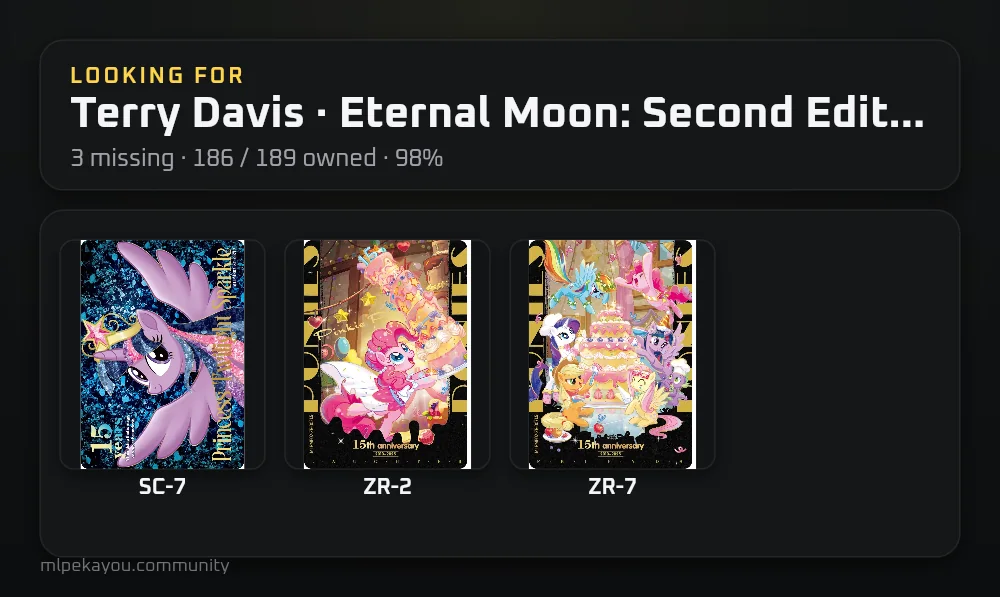
A looking for screen drawn by the bot, showing the three cards a member is missing from a set.
Looking for

mlpekayou.community is a collector site for My Little Pony Kayou cards with over 6,000 members and a 1,500-member Discord. The bot ties a Discord account to a site account so members can track and look up their cards without leaving the server, along with finding people to trade with. It is the app of mine with the most daily users.

The bot draws every screen itself. Profiles, collections and trade matches are rendered as images on a canvas and sent in Discord’s newer component frame, so it looks like the site and not like a wall of embeds.

Built with TypeScript, Discord API, Canvas.

Character botIn flightAn AI integrated Discord bot that plays as many characters as you can think of, each with its own name and face.
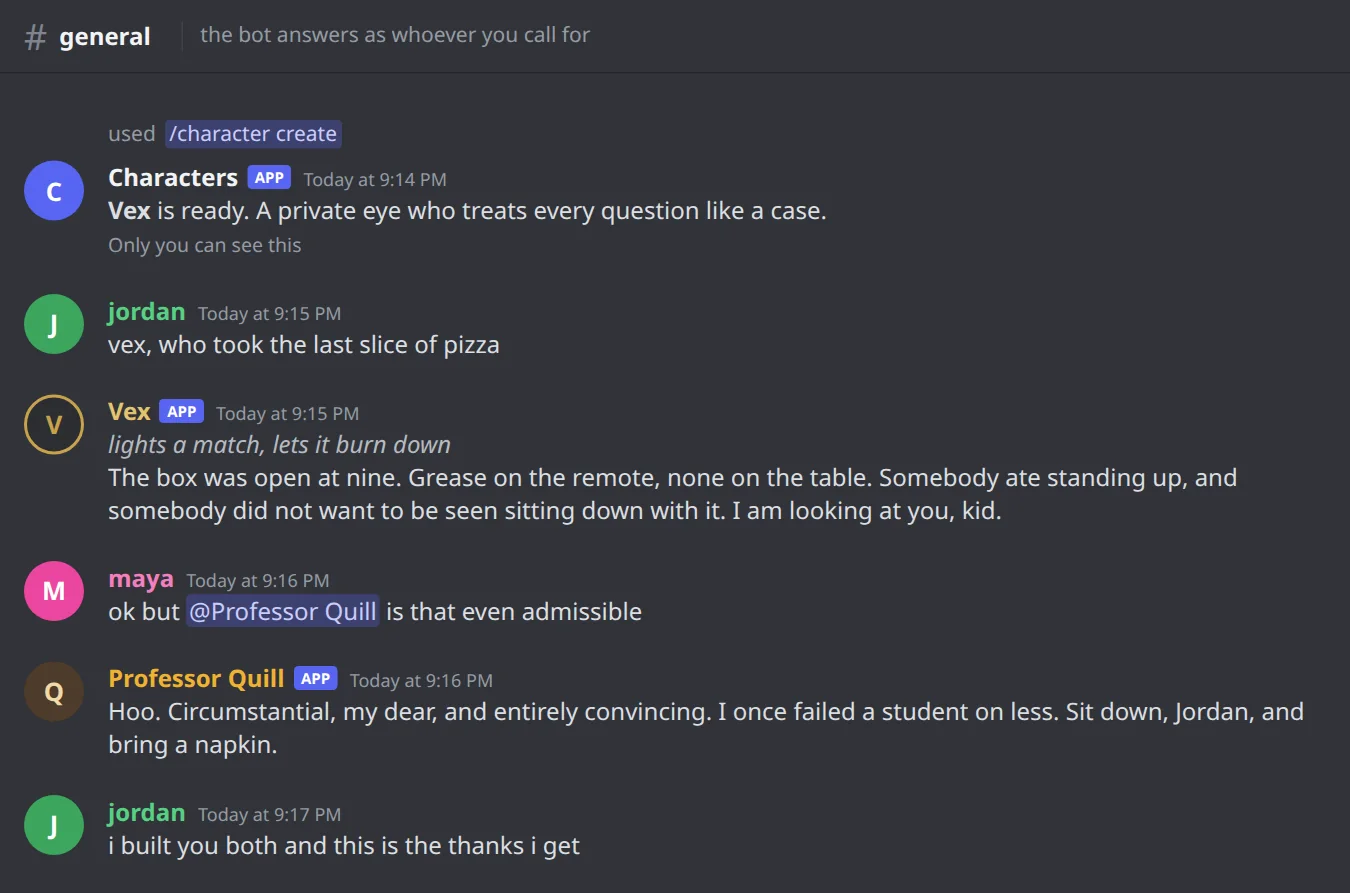
A mock of the bot in a Discord channel. A member creates a detective called Vex, asks him who took the last slice of pizza, and Vex and an owl called Professor Quill both answer in character.
In a server

Create characters, give each one a personality, and the bot answers as them through webhooks, so every character shows up with its own name and avatar. Running in a server with friends today and creates tons of funny moments. Open source once it is cleaned up.

Built with TypeScript, Discord API, Claude API.

AI trading deskOperationalPeaked at over 200 percent inside its first fifteen days. An AI desk that day trades my own account, with code holding the risk.
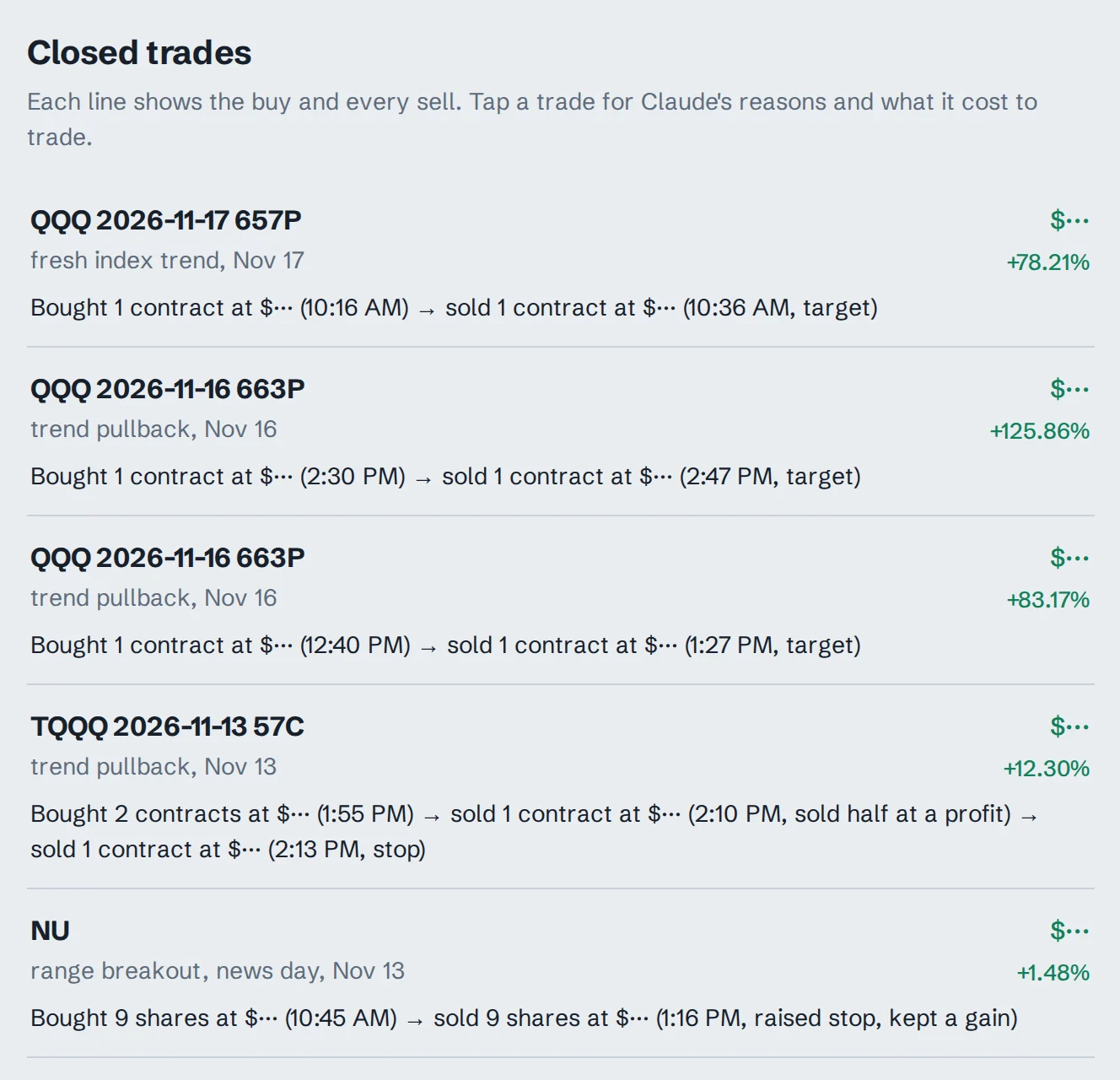
The list of closed trades, each with its setup, its entry and exit times, why it was sold, and its return. Dollar amounts are hidden.
Peak return
+219%
Reached
17 Nov 2026
Live since
2 Nov 2026
Closed trades
44

A desk that day trades my own brokerage account through the Robinhood MCP. It wakes before the open, reads what is moving and why, and takes a trade only when it sees a reason. Every entry has a thesis, a target and a stop written down before the order goes in.

The model decides. Code enforces. Claude never places an order itself. It runs as an unprivileged process that cannot read the broker token, and every decision passes a risk module that sizes the trade and can refuse it. Stops, targets and the daily loss limit are mechanical, so an exit never waits on a model. A watchdog, a shadow benchmark and a replay mode keep the record honest.

It went live on 2 November 2026 and peaked at 219 percent up on 17 November, measured on unit value so deposits do not count as gains. It wins under half of its trades and makes its money on the size of the winners. It is a small account and a short record, and I expect it to have bad weeks.

Built with Python, Claude, SQLite, Docker.

Operations

Platform development and automation at a CMMC compliant MSP.

More

Everything in this wing is restricted.

Platform development

Platform Developer at a compliance-focused MSP. Rollouts, automation and, more and more, development.

The team owns new product rollouts, internal and client-facing, plus automation, R&D, product development and acquisition integration. My part is the platform work: taking a security product to every client, the automations that remove repeat work from engineers, and the internal tooling nobody sells you.

The title has not changed but the job has. More of my time now goes to development with a larger dev team, at the moment on MCP servers for Copilot. The three jobs standing in this hall are that work.

Details stay inside the building. Ask me about it directly.

Built with PowerShell, Power Automate, Rewst, Pia, ConnectWise.

MCP servers for CopilotVendor MCP servers deployed to the company's Copilot, and in-house servers built with the dev team.
Vendor servers
Deployed
In-house servers
In build
My part
PRs and reviews
Status
Current focus

This is what I am working on now. An MCP server gives an AI assistant a safe, defined way to reach a system: look up a ticket, read a device’s state, check a tenant. The goal is for our engineers to ask Copilot a question and get an answer from the tools we already run.

There are two halves. One is taking the MCP servers our vendors publish and deploying them to our Copilot, with the access and guard rails an MSP needs. The other is building our own for the systems nobody ships one for. That half is a team effort. I submit pull requests, review the ones other teams send, and none of it is mine alone.

It follows on from earlier internal tooling: Copilot agents that answer from our own knowledge, and ConnectWise extensions that put the right action one click away.

Built with MCP, Copilot, ConnectWise.

Product rollouts at scaleSecurity products taken from pilot to the whole client fleet, one product a quarter, owned start to finish.
Endpoints on SIEM
5,000+
Identities watched
Thousands
Pace
One product a quarter
First client
Ourselves

Rolling a security product out across a client base is a deployment problem, a data problem and a communication problem at once. I have run these for identity threat detection, DNS filtering, desktop encryption and SIEM, among others. Each one is mine for the quarter it takes.

It starts in house. We run the product on ourselves first, and what breaks there becomes the procedure the service desk works from. Then I build the deployment and validation tooling that takes it from pilot to every endpoint or identity, the reporting that proves it landed, and the monitoring checks that catch a tenant drifting out of line before a client does.

Built with ITDR, DNS Filtering, Disk Encryption, SIEM.

Workflow automationAutomation built across Pia, Rewst and Power Automate, with user onboarding and offboarding at the centre.
Orchestrators
Three
Onboarding steps carried
A dozen
Hands on keyboard
None

We run three orchestrators and I build in all of them, picking whichever fits the job.

Most of the work has gone into bringing users on and taking them off. Onboarding at an MSP is the same dozen steps repeated across many client tenants, each with its own quirks. The automation takes the request and carries it through account creation, licensing, groups, devices and the client-specific extras, then reports back. Engineers review the result instead of doing the steps.

The rest is built as the need comes up: reports that reconcile licenses between portals so the mismatches get fixed, scheduled rotation of the global admin passwords across client tenants, forwarding of text messages to email, and a long tail of smaller jobs.

Built with Pia, Rewst, Power Automate, PowerShell.

Credentials

Networking, security, endpoints and the cloud, eight films on the viewers.

More

Certifications

  • AZ-900 Azure FundamentalsMicrosoft
  • CCNACisco
  • CCNA CybersecurityCisco
  • eJPTINE SecurityVerify
  • Certified in CybersecurityISC2
  • MD-102 Endpoint AdministratorMicrosoft
  • SC-900 Security, Compliance, and Identity FundamentalsMicrosoft
  • Security+CompTIA

Containment

Offensive security work. Most of it stays sealed until disclosure clears.

More

First disclosure

Pending release

Program and vendor withheld until publication.Impact class withheld until publication.

This bay is sealed until disclosure. What can be said now: the report was accepted, and the finding ends at a root shell over SSH on a host that was never meant to offer one. No fix is in flight on the vendor’s side yet, so everything else stays in the bay.

Opens when the program's disclosure clears.

Second disclosurePending releaseA second report, with a different program. Through triage and waiting on a reply.

Program and vendor withheld until publication.Impact class withheld until publication.

A second report, filed with a different program. It is through triage and waiting on a reply. Everything else stays sealed until that program says otherwise.

Opens when that program allows it.

Practice rangeOperationalWhere the offensive skills get kept sharp between real targets.

Some of my favorite free time activities include reverse engineering, CTF events and challenges (Huntress 2026, Hack the Box), and malware analysis.

Personnel file

Jordan Eldridge. 23. Self-taught. Platform Developer at a compliance-focused MSP.

More

I learned by building things people needed and fixing them when they broke. At work I am a Platform Developer at a compliance-focused MSP, on the team that rolls out new products, automates the repeat work, and integrates what the company acquires. PowerShell, Power Automate, Rewst and Pia are the daily tools.

Outside work I run a few things with real users, ship products under JEL, and spend my remaining hours on security research. This site is the one place all of it lives.

2022
First open source contributions.
2024
Got hired at MSP and began gathering credentials.
2026
Began shipping products. First bug bounty accepted. jel.dev live.

Built on Astro and Three.js. Models and textures from Poly Haven (CC0), and the GameCube controller by CoryRichards (CC BY 4.0).